
Why Does Every Week Bring Another AI Agent Framework?
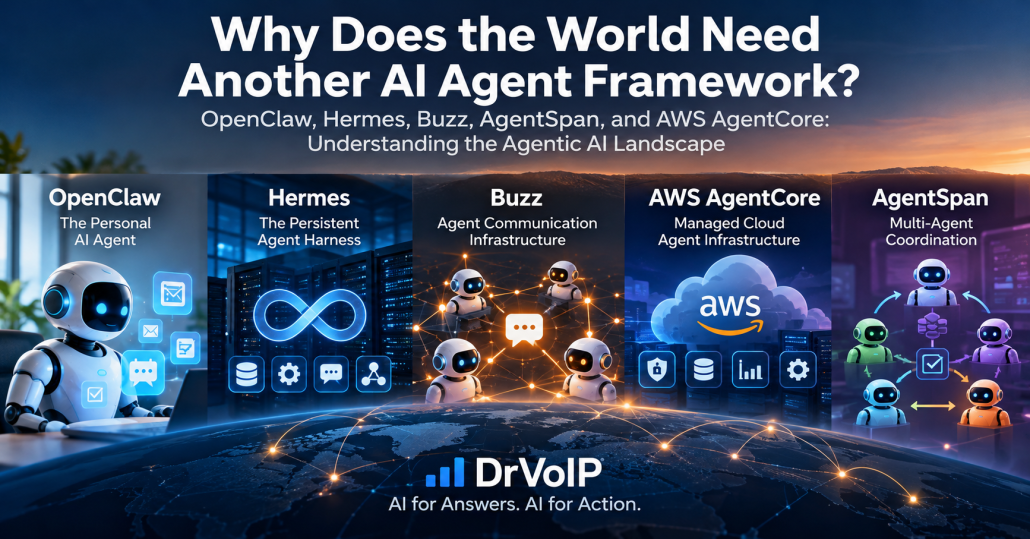
OpenClaw, Hermes, Buzz, AgentSpan, and AWS AgentCore: Understanding the Agentic AI Landscape
Hardly a week goes by without another announcement of a new AI agent framework, harness, runtime, or orchestration platform.
OpenClaw. Hermes. Buzz. AgentSpan. AWS Bedrock AgentCore. CrewAI. LangGraph. The list seems to grow almost daily.
For those of us who have spent decades watching technology evolve, this explosion of competing solutions raises an obvious question:
What problem are we trying to solve that requires yet another framework?
Are these genuinely different approaches to building autonomous systems, or are we witnessing another round of developers reinventing the wheel?
Having spent time evaluating several of these technologies, I believe the answer is more interesting than either explanation.
We are witnessing an industry attempting to define the operating architecture for an entirely new class of software: autonomous digital workers.
From AI for Answers to AI for Action
For the last several years, much of the excitement surrounding artificial intelligence has focused on large language models and their remarkable ability to generate useful answers.
Ask a question. Receive an answer.
That is enormously valuable, but it is not the same as having an AI system accomplish a business objective.
Consider the difference between these two requests:
"What is our company's policy for handling customer complaints?"
And:
"Review yesterday's customer complaints, identify those requiring escalation, create the appropriate support tickets, notify the responsible managers, and prepare a summary for tomorrow's operations meeting."
The first request requires information retrieval and reasoning.
The second requires planning, tools, permissions, memory, workflow execution, error handling, and potentially coordination among several specialized AI agents.
This is the transition from AI for Answers to AI for Action.
It is also where the architectural challenges begin.
What Exactly Is an Agent Framework?
One source of confusion is that we frequently use the term "framework" to describe technologies that perform fundamentally different functions.
A framework might provide a programming model for defining agents.
An agent harness might provide the execution environment, tools, context management, and operational loop that allow an agent to perform work.
An orchestration platform might coordinate multiple agents and manage dependencies between their tasks.
A communication infrastructure might provide the transport and routing mechanisms through which agents exchange messages.
A managed runtime might provide the security, isolation, observability, and scaling needed to operate agents in production.
These are related capabilities, but they are not interchangeable.
Comparing them without recognizing those differences is rather like comparing a database, an operating system, a message broker, and a cloud hosting service.
All are important components of an application, but they solve different problems.
Five Approaches to the Agentic Problem
Let's examine five technologies that illustrate the different directions this market is taking.
OpenClaw: The Personal AI Agent
OpenClaw represents an approach centered on a persistent AI assistant capable of interacting with tools, applications, and messaging systems.
Its appeal is the ability to move beyond a traditional question-and-answer interface and create an assistant that can perform tasks on behalf of its user.
The emphasis is on the agent as an operational assistant rather than simply a language model.
That introduces important questions about tool permissions, execution boundaries, persistent state, and the security implications of granting an AI system access to external applications.
Hermes: The Persistent Agent Harness
Hermes approaches the problem through a persistent agent environment with tools, memory, sessions, and messaging integrations.
Rather than requiring a developer to construct every operational component from scratch, Hermes provides much of the surrounding infrastructure needed to run an agent.
Its gateway architecture also allows agents to interact through external messaging platforms.
However, a persistent agent environment should not automatically be confused with a distributed multi-agent orchestration system.
Running several agents and coordinating hundreds of specialized agents across multiple systems are different engineering challenges.
Hermes illustrates the growing importance of the agent harness as a distinct architectural component.
Buzz: Agent Communication Infrastructure
Buzz introduces another perspective: communication between independently operating agents and the infrastructure supporting those interactions.
As agentic systems become more distributed, communication becomes a fundamental architectural concern.
How does one agent discover another? How are messages delivered? How are conversations correlated? How do we establish identity and trust? How do we recover from interrupted sessions or failed communication?
These questions are familiar to anyone who has worked with distributed computing or telecommunications systems.
Buzz is particularly interesting when viewed through that architectural lens.
Communication infrastructure is not the same thing as agent intelligence or workflow orchestration, but it may become an essential component of increasingly distributed agentic environments.
AWS Bedrock AgentCore: Managed Agent Infrastructure
AWS Bedrock AgentCore approaches the problem from the perspective of operating AI agents in a managed cloud environment.
Its capabilities address concerns such as runtime execution, identity, memory, observability, and controlled access to tools.
This is particularly important for enterprise applications, where an agent must operate within defined security and governance boundaries.
AgentCore is not simply another alternative to a developer's preferred orchestration library.
It provides managed infrastructure that can support agents built using different development approaches.
For organizations already invested in AWS, the attraction is the ability to integrate agent execution with established cloud security and operational practices.
However, managed infrastructure does not eliminate the need to design the agent's reasoning, workflow, failure recovery, or business logic.
AgentSpan: Coordination and Multi-Agent Systems
AgentSpan brings attention to another major challenge: coordinating multiple agents working toward a common objective.
Multi-agent architectures introduce problems that do not necessarily appear when operating a single autonomous assistant.
Who assigns the work? How are tasks divided? How do agents share context? Who resolves conflicting results? How do we prevent agents from repeating work or entering unproductive loops?
Coordination becomes increasingly important as organizations move from isolated agents to collaborative systems.
The larger architectural question is how multi-agent coordination should interact with the underlying runtime, messaging, and security infrastructure.
Comparing Architectural Roles
The following table summarizes the primary architectural perspective of each technology.
| Technology | Primary Perspective | Architectural Question |
|---|---|---|
| OpenClaw | Personal AI assistant and agent execution | How does an AI assistant perform useful work? |
| Hermes | Persistent agent harness and gateway | How do we operate an agent over time? |
| Buzz | Agent communication infrastructure | How do independently operating agents communicate? |
| AWS AgentCore | Managed cloud agent infrastructure | How do we run agents securely at enterprise scale? |
| AgentSpan | Multi-agent coordination | How do multiple agents work toward a common objective? |
These categories describe the architectural perspectives being compared, not exclusive capabilities or complete feature inventories. The platforms may overlap, and their capabilities continue to evolve.
Download the Full Agentic AI Framework Comparison
This article introduces the major architectural differences between today's agentic platforms. For readers interested in a more detailed technical examination, DrVoIP has prepared a comparison covering:
- Architecture and deployment models
- Agent execution and orchestration
- Single-agent versus multi-agent capabilities
- Memory and context management
- Communication and messaging
- Security, identity, and governance
- Scalability and operational management
- Integration with enterprise applications
- Appropriate use cases and limitations
Agentic AI Framework Comparison: 2026 Edition
Request the Full Technical Comparison →
Visit the DrVoIP Resources library to request your personal download link by email.
Request this resourceWhy Are We Reinventing the Wheel?
Having worked through several generations of computing technology, I find the current agentic AI landscape strangely familiar.
We have seen this pattern before.
In the early days of personal computing, developers created competing operating systems, development environments, networking protocols, and application architectures.
During the emergence of the Internet, we experienced similar competition among web servers, application servers, middleware platforms, and databases.
Cloud computing introduced another wave of experimentation before widely accepted architectural patterns began to emerge.
Agentic AI appears to be following a similar evolutionary path.
We are not simply witnessing competition between software products.
We are watching the industry experiment with the fundamental architecture of autonomous computing.
The Problems We Have Not Yet Solved
Several important questions remain open.
1. Who Controls the Agent?
Should an agent operate independently, or should every significant action require human approval? How do we define the limits of its authority?
2. Where Does Memory Live?
Should memory belong to the individual agent, the application, or a shared enterprise service? How do we prevent stale or incorrect information from influencing future decisions?
3. How Do Agents Communicate?
Should agents communicate through traditional APIs, message queues, event buses, or specialized agent protocols? How should identity, authorization, and trust be established?
4. Who Coordinates the Work?
When multiple agents participate in a business process, which component determines task ownership, sequencing, and completion? What happens when two agents disagree?
5. How Do We Scale?
A system supporting one personal agent may behave very differently from an enterprise environment supporting thousands of concurrent agent sessions.
Execution isolation, resource allocation, latency, observability, and cost management become major concerns.
6. Who Is Accountable?
When an agent takes an action that changes a customer record, issues a refund, or initiates a business transaction, who is responsible?
How do we audit its decisions and reconstruct what happened?
These are not simply programming problems. They are architectural, operational, and organizational challenges.
Perhaps We Are Asking the Wrong Question
When comparing these technologies, the natural inclination is to ask:
"Which framework will win?"
But perhaps that is the wrong question.
Consider a modern enterprise application.
It might use AWS for infrastructure, PostgreSQL for data storage, Redis for caching, and an API gateway for application integration.
None of these components must replace the others. They perform complementary functions.
Why should agentic AI be different?
A future enterprise solution might use one framework to define agent behavior, another component to coordinate tasks, a communication layer to exchange messages, and AWS AgentCore to provide managed execution and operational controls.
The winning architecture may not be a single framework.
It may be the architecture that allows multiple technologies to work together reliably, securely, and economically.
What Should an Enterprise Architect Do Today?
My recommendation is to resist the temptation to select an agent framework before defining the business problem.
Start with the desired outcome.
Does the application require a persistent personal assistant? Does it require several specialized agents to collaborate? Does it need secure access to enterprise systems and customer information?
Will it operate continuously, or only when triggered by a business event? What happens when an agent fails? How will we measure whether the system is delivering value?
Once these questions are answered, the appropriate technology choices become considerably clearer.
And in many cases, the correct answer may involve more than one framework.
The Bigger Picture
I suspect we are still in the early stages of defining what an autonomous software system should look like.
The current proliferation of frameworks, harnesses, runtimes, and communication platforms is evidence of an industry searching for the right architectural abstractions.
Some projects will disappear. Others will merge. Some will become widely adopted infrastructure components.
And standards will eventually reduce the need to reinvent common functionality.
But the underlying direction seems clear.
We are moving beyond systems that simply answer questions toward systems that can execute meaningful business work.
That transition will require more than smarter language models.
It will require an entirely new generation of software architecture.
AI for Answers, AI for Action.
Join the Conversation
Are you experimenting with OpenClaw, Hermes, Buzz, AgentSpan, AWS AgentCore, or another agentic platform?
What architectural challenges have you encountered?
I'd be interested in hearing whether you believe the industry needs more frameworks or fewer.
Peter S. Buswell (DrVoIP)
AI for Answers, AI for Action.
