
You’re Part of a Billion-Node IoT Network… and Nobody Asked You?

Your iPhone is quietly powering a global tracking network

That’s not a sci-fi teaser, that’s how Apple AirTags actually work.

On the surface, an AirTag looks simple: a little white button with no visible antenna, no GPS module, and a battery that lasts for months. Yet somehow it can tell you where your keys, bags, or luggage are, even when they’re halfway around the world.

So what’s really going on here?


AirTags Don’t Phone Home by Themselves

AirTags are not tiny GPS satellites. They don’t have cellular radios. They’re not talking directly to space.

Instead, they use a very clever trick:

  • Each AirTag emits a low-power Bluetooth signal.
  • Any nearby Apple device (iPhone, iPad, Mac) that’s part of Apple’s Find My ecosystem can quietly “hear” that signal.
  • That Apple device then sends the AirTag’s encrypted location data up to Apple’s cloud.
  • You open the Find My app and see where your AirTag is on the map.

The magic is not in the tag itself. The magic is in the billions of Apple devices already in people’s hands, pockets, backpacks, and briefcases.


You Are the Network

Here’s the real fun (and slightly unsettling) fact:

Every compatible Apple device around you is quietly participating in a global, crowdsourced sensor network. Your iPhone might be helping some stranger find their lost backpack at the airport, even if you’ve never owned an AirTag in your life.

This is possible because:

  • Apple has huge device density in most cities and airports.
  • Each device only needs to send tiny bits of encrypted location data.
  • The user doesn’t have to “join” a program – the capability ships in the operating system.

The result is a billion-node IoT network that Apple didn’t have to deploy as new hardware. It was built on top of devices people were already buying anyway.


Brilliant… and a Little Spooky

From an engineering and network design perspective, this is a beautiful pattern:

  • Leverage existing endpoints (phones, tablets, laptops).
  • Use low-energy local radios (Bluetooth) instead of expensive GPS/cellular in every tag.
  • Let the cloud do the heavy lifting for aggregation and “find my stuff” intelligence.

From a privacy and security perspective, it naturally raises questions:

  • How much of my device is participating in networks I didn’t explicitly sign up for?
  • What else could be built on top of this kind of mesh?
  • Where is the line between “clever use of infrastructure” and “silent exploitation of it”?

To Apple’s credit, the system is designed to be encrypted and anonymous. The idea is that your phone doesn’t know whose AirTag it just heard, and Apple doesn’t reveal who’s relaying what. But architecturally, it still shows just how powerful it is when a vendor controls both the devices and the cloud.


What This Means for IoT and the Rest of Us

If you think about it, the AirTag model is a preview of where a lot of IoT is headed:

  • Crowdsourced coverage: Use devices people already own, rather than deploying new towers or gateways everywhere.
  • Edge + cloud cooperation: Tiny, simple devices at the edge; heavy lifting, storage, and analytics in the cloud.
  • Invisible participation: The “network” is baked into the platforms and operating systems we use every day.

For business and technology architects, this raises some interesting design questions:

  • Where could you leverage existing devices or platforms, instead of building your own network from scratch?
  • How do you balance convenience and capability with transparency and consent?
  • And how do you explain all of this to non-technical stakeholders in a way that builds trust rather than fear?

So Yes… You’re in the Network

Next time you see “Find My” locate an AirTag on the other side of the airport, remember:

  • That little tag isn’t doing it alone.
  • Your devices – and everyone else’s – are quietly part of the story.

Whether you find that exciting, unsettling, or a bit of both, it’s a perfect example of how modern cloud, mobile, and IoT architectures really work under the hood.

And if you’re building customer experiences, contact centers, or IoT-style applications, this is the kind of architecture pattern that’s worth understanding – and maybe borrowing.
If the Internet Was Built to Be Self-Healing, Why Do Cloud Outages Take Us Down?

Old-school ARPANET lore promised us a different world: a self-healing network with no single point of failure. Routers could go down, links could break, and packets would just find another path. The design goal was clear – resilience, not perfection.

Fast-forward to today. We wake up to headlines about “major internet outages” tied to a handful of providers: Cloudflare, AWS, and other global platforms. Entire sectors stall. Contact centers go dark. SaaS dashboards spin uselessly while customers wait on hold.

If the internet was engineered to route around failure, how did we end up here?


If the internet is designed to be redundant, why are we at the mercy of cloud outages?

From Distributed Network to Centralized Cloud

The original internet was a federation of networks – many independent operators, many paths, many owners. No single company “owned” your traffic end-to-end.

Today’s reality looks very different:

  • A handful of hyperscalers host a massive percentage of the world’s applications.
  • Most web traffic flows through a small set of CDNs and security proxies.
  • DNS, TLS termination, WAFs, APIs, databases, and AI services are all concentrated in shared platforms.

In the pursuit of speed, cost savings, and convenience, we quietly traded diversity for consolidation. The result: the internet is still “distributed” on paper, but business-critical traffic is often funneling through the same few chokepoints.

Efficiency Beat Resilience

Cloud and edge services won because they are extremely good at:

  • Reducing operational overhead – no hardware to buy, patch, or rack.
  • Improving performance – CDNs and global PoPs put content close to users.
  • Standardizing security – WAF, DDoS protection, and TLS at scale.
  • Simplifying architecture – one vendor, one bill, one control plane.

The trade-off? What used to be a thousand small risks became a few large, correlated risks. When a provider at the center of your architecture stumbles, your redundancy plan may not be as redundant as you thought.

The New “Utilities” of the Internet

Whether we admit it or not, companies like AWS, Cloudflare, Microsoft, Google and others have become the utilities of the digital age. They are to the internet what power companies are to a data center.

When those utilities have a bad day, it’s not just a “service disruption” – it’s a business outage:

  • Contact centers can’t accept or route calls.
  • Web portals and mobile apps are unreachable.
  • Back-office systems that depend on APIs fail at scale.

We didn’t lose the self-healing properties of the underlying internet. We simply built a new, fragile layer on top of it and moved everything important there.

Why Do Outages Cascade So Quickly?

Modern architectures are deeply interdependent. A single issue can cascade because:

  • DNS for multiple providers is handled by the same platform.
  • Authentication (OAuth, SSO, IAM) depends on a central service.
  • APIs call other APIs, which call still more APIs, all in the same region or cloud.

What looks like “one outage” is often a chain reaction: break one link in the chain and a stack of other services falls over with it.

What Can Businesses Do About It?

The answer is not to abandon the cloud. The answer is to stop assuming “we’re in AWS” or “we use Cloudflare” = “we’re resilient.” Real resilience requires intentional design.

Some practical moves:

  • Multi-DNS and multi-path connectivity – Avoid a single DNS or edge provider where it makes sense.
  • Multi-region or multi-cloud for critical workloads – Especially customer-facing or revenue-generating systems.
  • Local failover for contact centers – Alternate routing, backup carrier paths, and “degraded mode” operations when the cloud has a bad day.
  • Private LLMs and local inference – For AI-driven workflows, don’t put every decision on a single external endpoint.
  • Runbooks and drills – Treat cloud outages like you would a power failure or disaster recovery exercise.

In other words: you can’t prevent provider outages, but you can prevent them from turning into a total business blackout.

The Internet Kept Its Promise. We Forgot Ours.

The underlying internet still does what it was designed to do: move packets around broken links and failed routers. The fragility comes from the way we’ve rebuilt the higher layers – centralized, convenient, and dangerously dependent on a small group of providers.

It’s time to revisit the original goal: no single point of failure. Only now, the conversation isn’t about router paths – it’s about architecture, cloud strategy, and where you place your digital “eggs.”

If you’d like to review how your contact center, customer experience stack, or AI services would behave during the next big outage, that’s exactly the kind of scenario planning we do every day at DrVoIP.

DrVoIP — Where IT Meets AI — in the Cloud.
Visit DrVoIP.com to start the conversation.

Why Companies Are Choosing Private LLMs Over Public AI Models in 2025

Our own LLM!

By DrVoIP — Where IT Meets AI, in the Cloud

Introduction: The Shift Toward Private Intelligence

AI has moved from “interesting demo” to mission-critical infrastructure. As organizations push AI deeper into customer interactions, agent assistance, knowledge operations, and forecasting, the uncomfortable truth becomes clear:

You can’t run your business on someone else’s brain.

Below are the top reasons enterprises are shifting from public, shared AI models to private, domain-trained LLMs deployed on platforms like Amazon Bedrock, SageMaker, HuggingFace, ECS, EKS, or on-prem GPU infrastructure.


1. Security: Your Data Stays Inside Your Walls

Public LLMs require that your prompts and context be sent to a third-party model host. Even with “no training” guarantees, the risk profile remains.

  • Controlled data paths
  • No external logging
  • Compliance with HIPAA, PCI, SOX, FedRAMP
  • Private VPC deployment with IAM + KMS protection

For Contact Centers handling customer PII, private models are no longer optional.


2. Confidentiality: Your IP Is a Strategic Asset

Your internal knowledge is part of your competitive moat—price lists, contracts, troubleshooting workflows, customer history, engineering diagrams, HR processes.

A private LLM ensures this data never crosses a public AI boundary.


3. Pre-Training Advantages: A Private Model Speaks Your Language

Public LLMs are brilliant generalists. Your organization is not.

A private model can be:

  • Pre-trained on your domain data
  • Fine-tuned on historical conversations
  • Aligned with your brand voice
  • Optimized for Amazon Connect, Lex, Q, Bedrock KBs, or internal APIs

Public LLMs are smart. Private LLMs are smart for your business.


4. Predictable Costs & Lower Long-Term Spend

Public LLM costs spike with usage—long prompts, concurrency surges, large context windows.

Private LLMs offer:

  • Predictable inference cost
  • Control over hardware (GPU / CPU)
  • Scaling designed for your traffic patterns
  • Sharable infrastructure across business units

Heavy users (contact centers, finance, healthcare) see major savings.


5. Governance, Compliance & Control

Businesses require:

  • Audit logs
  • Model versioning
  • Content guardrails
  • Explainability
  • Responsible-AI policies
  • Data residency guarantees

Public LLMs simply cannot satisfy all enterprise controls. Private deployments can.


6. Performance: Faster, Closer, and Tuned for Real-Time Systems

Deploying a private LLM in your AWS Region—or even inside your VPC—results in:

  • Lower latency
  • Higher throughput
  • Custom prompt flows
  • Ability to embed proprietary knowledge directly

For Amazon Connect agent assistance and customer self-service, latency is everything.


7. Independence From Vendor Roadmaps

Public LLMs come with strings:

  • Model changes outside your control
  • Pricing changes
  • Content restrictions
  • Outages
  • Usage limits

A private LLM frees you from third-party constraints.


8. Strategic Advantage: Your Model Becomes a Business Asset

A private LLM becomes a:

  • Productivity engine
  • Knowledge hub
  • Agent assistant
  • Training system
  • CX multiplier
  • Competitive moat

This AI capability becomes part of your intellectual property, not something rented.


9. Compute Reality Check: Running Your Own LLM Is Easier in 2025

Modern optimizations make private models practical without massive infrastructure:

  • Quantization
  • MLX, llama.cpp, vLLM, TGI
  • Smaller 1B–7B domain models
  • AWS-managed deployments (Bedrock Custom Models, SageMaker Endpoints)

You no longer need racks of GPUs—just smart engineering.


Conclusion

Public LLMs are excellent for experimentation. But running your business on them is like storing your customer database on a public Google Doc.

Private LLMs offer:

  • Security
  • Confidentiality
  • Performance
  • Lower long-term cost
  • Operational control
  • A genuine strategic advantage

If your organization is exploring private or hybrid LLM architectures, DrVoIP can help you design a strategy that fits your business, budget, and existing cloud investments.

Where IT Meets AI — in the Cloud.

The Inevitable Shift: AI, Jobs, and Business Survival

By DrVoIP — Where IT Meets AI in the Cloud

🧠 The Inevitable Shift: AI, Jobs, and Business Survival

Every major technology shift follows a familiar pattern: disruption, resistance, and redesign. Artificial Intelligence and robotics are accelerating that cycle. Productivity is rising while roles are being rewritten, and it’s happening faster than most organizations can adapt.

This isn’t political—it’s practical. Once automation compounds, there’s no turning back the clock. The real question is: how do we adapt?


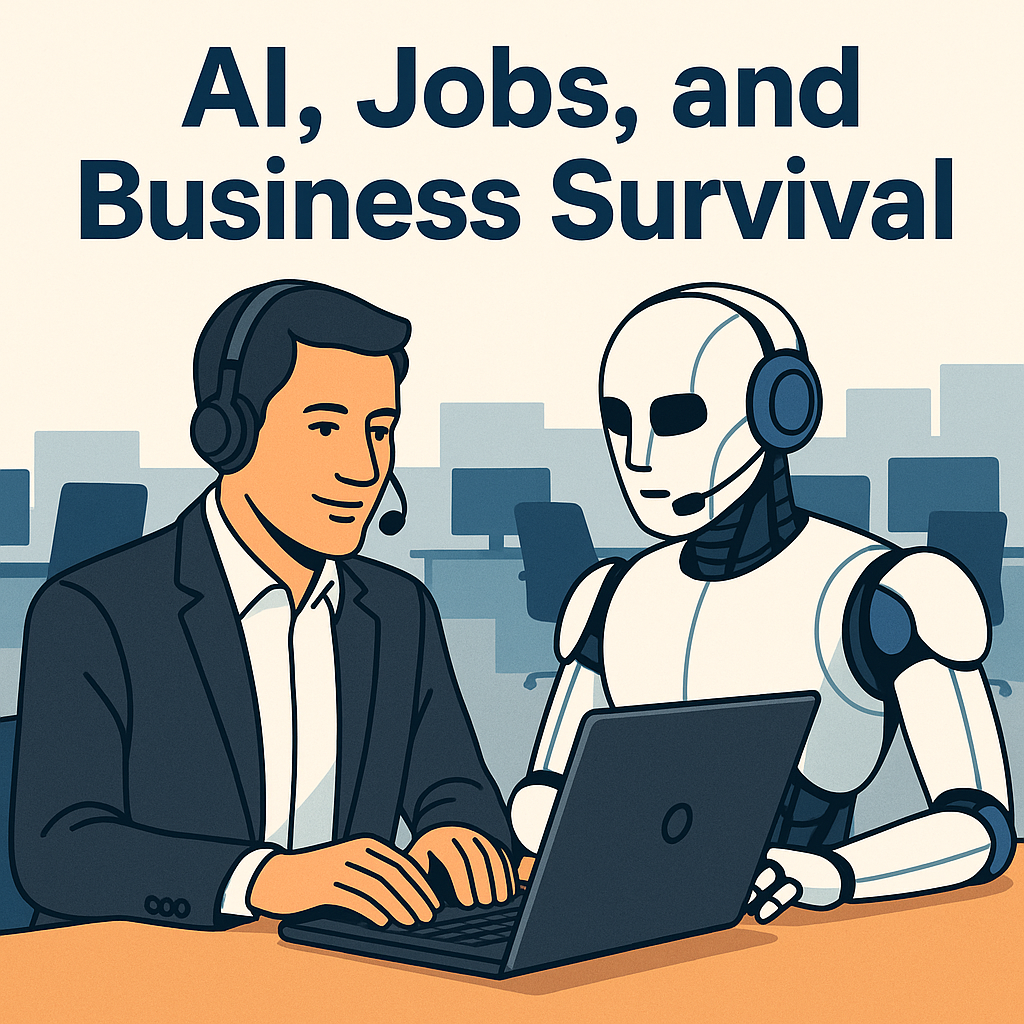
Cartoon of a contact center agent collaborating with a friendly AI robot at a laptop
AI and humans working side by side to elevate customer experience.

The Contact Center: Ground Zero for Change

Nowhere is this transformation more visible than in the modern contact center. For years, teams tried to balance efficiency with empathy. AI is changing the equation.

  • Amazon Q helps agents surface the best answer instantly.
  • Lex chatbots resolve common requests before they reach a live agent.
  • Bedrock Knowledge Bases keep bots and humans aligned to current policies, pricing, and procedures.

The result isn’t fewer agents—it’s freed agents, focused on complex conversations and relationships that drive loyalty and revenue.

From Job Loss to Job Lift

The fear of job loss is real, but the smarter narrative is job lift. As AI takes over repetitive tasks, teams can move up the value chain.

  • Agents evolve into AI orchestration specialists who manage digital + human workflows.
  • Supervisors shift from monitoring handle time to coaching customer outcomes.
  • Operations invests in journey design, data quality, and knowledge governance.

Responsible AI Is a Leadership Mandate

The debate is no longer whether to use AI—it’s how to use it responsibly.

  • Transparency: Be clear about where and how AI is assisting.
  • Retraining: Fund programs that help employees move up the value chain.
  • Governance: Maintain tight control over data sources and knowledge freshness.

Organizations that invest in responsible automation will not just survive—they’ll lead the next decade of growth.

Final Thoughts

AI isn’t the enemy of workers—it’s the next step in how we deliver value. The winners embrace automation as augmentation, not replacement.

If you’re ready to explore how Amazon Connect, Lex, Bedrock, and Q can modernize your customer experience, let’s talk.

📩 Email: Grace@DrVoIP.com
🔗 Website: DrVoIP.com
🎥 YouTube: @DrVoIP


About DrVoIP

DrVoIP helps organizations deploy AI-powered customer experience on AWS—fast. From Q for Connect and Lex chatbots to Bedrock Knowledge Bases and real-time analytics, we build practical automations that scale.